
Emergency kit guide
The 72-hour survival bag
One bag per household with the basics for the first days of an emergency. Ready.gov recommends supplies for several days; we plan for 72 hours as a practical target.
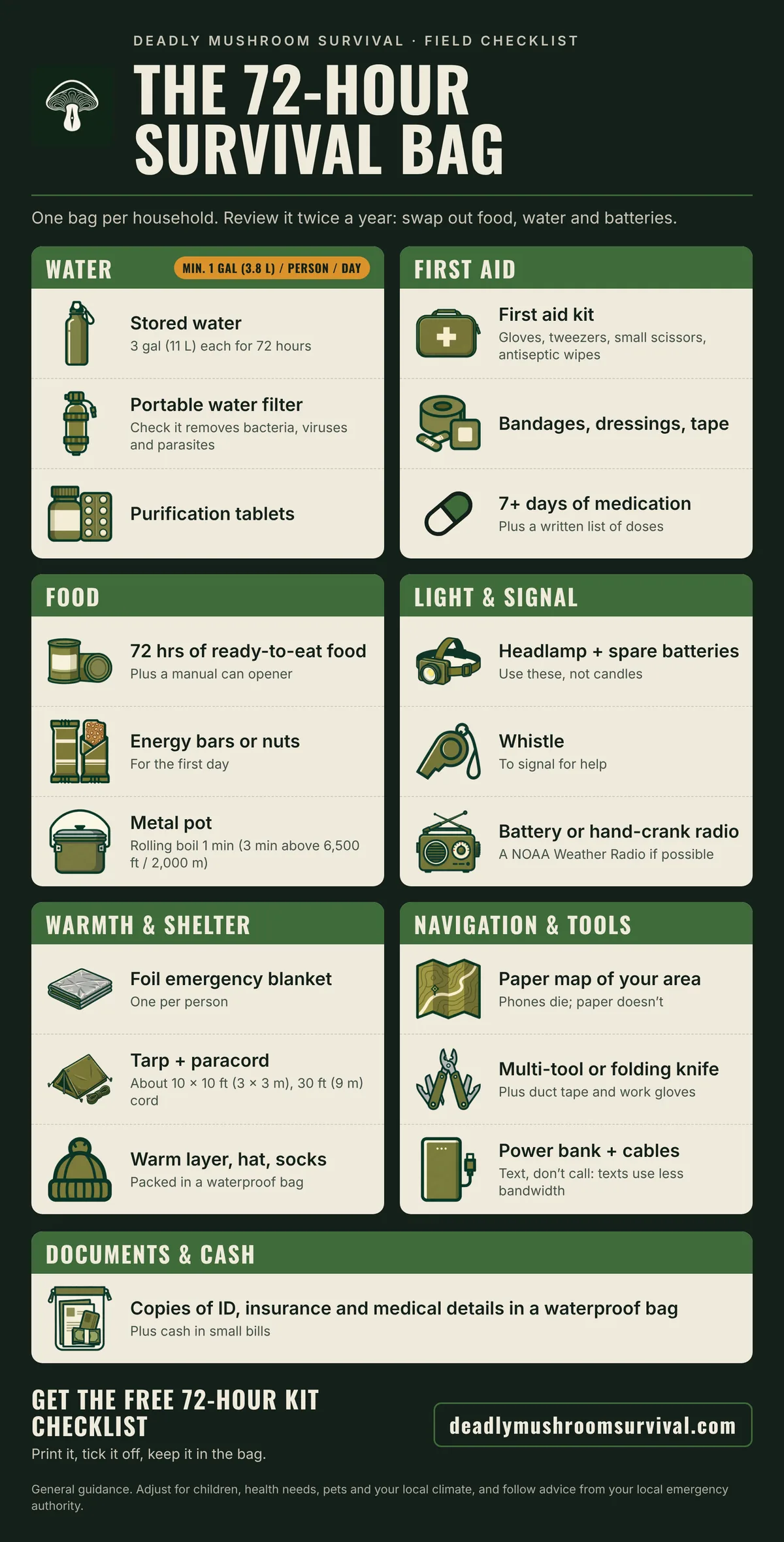
Key points (text version)
From the Ready.gov basic kit list
Water and food
- Water: at least 1 gallon (3.8 L) per person per day, for several days, for drinking and sanitation. For 72 hours that is 3 gallons (11 L) each.
- Food: a several-day supply of non-perishable food, and a manual can opener.
Light, power and signals
- Flashlight and extra batteries.
- Battery-powered or hand-crank radio, plus a NOAA Weather Radio with tone alert.
- Whistle, to signal for help.
- Cell phone with chargers and a backup battery.
First aid and health
- First aid kit (see our first aid kit guide).
- Prescription medications, and non-prescription medications such as pain relievers.
- Prescription eyeglasses and contact lens solution.
Clothing, warmth and shelter
- A sleeping bag or warm blanket for each person.
- A complete change of clothing for your climate, and sturdy shoes.
- Plastic sheeting, scissors and duct tape, to shelter in place.
Hygiene, tools and documents
- Moist towelettes, garbage bags and plastic ties for personal sanitation, plus soap and hand sanitizer.
- A dust mask, to help filter contaminated air.
- Local maps.
- Important family documents in a waterproof, portable container (or saved electronically), and cash.
- Matches in a waterproof container.
Ready.gov also advises replacing expired items as needed and re-thinking your needs every year.
Our additions to the Ready.gov list
These items are in our free checklist. They are practical suggestions of ours, not part of the Ready.gov list.
- A foil emergency blanket for each person.
- A tarp (about 10 × 10 ft / 3 × 3 m) and 30 ft (9 m) of paracord.
- A warm layer, hat and spare socks in a waterproof bag.
- Energy bars or nuts for the first day.
- A metal pot or bottle you can boil water in, plus a portable filter or purification tablets (see how to make water safe).
- A multi-tool or folding knife, plus work gloves.
- A power bank and charging cables.
- A week or more of any personal medication, with a written list of doses. Ask your pharmacist how to rotate it.
- Text instead of calling: texts use less bandwidth.
- Review the bag twice a year to swap out food, water and batteries.
Sources
General information only. Adjust for your health, family, pets and local conditions, and follow advice from your local emergency authority.
More guides
- Power out? Do thisWhat to have ready, what to do and when to throw food away.
- Make water safe to drinkBoil, disinfect or filter: the CDC steps for emergency water.
- Build a first aid kitThe Red Cross list for a family of four, with quantities.
- Car emergency kitWhat Ready.gov suggests keeping in your vehicle.